The Preacher with a Knife: Harry Powell and the Violence of Borrowed Faith

An Independent Daily Strange Investigation into Charles Laughton’s The Night of the Hunter (1955)
Standfirst
Harry Powell wears the language of salvation as convincingly as he wears his preacher’s black suit. In Charles Laughton’s The Night of the Hunter, Robert Mitchum creates a murderer whose most consequential weapon is neither his knife nor his ability to inspire fear, but the willingness of respectable people to mistake religious performance for moral authority. Beneath the film’s extraordinary fusion of Southern Gothic, expressionist cinema and childhood fable lies a harsher question: what happens when a community has learned to recognise the appearance of goodness more readily than its evidence?
The Man Who Carries His Sermon on His Hands
Robert Mitchum’s Harry Powell holds up his hands, and a moral universe appears to be written across his fingers. LOVE occupies the knuckles of his right hand; HATE marks the left. He brings them together, sets them against one another and transforms the movement into a sermon about the struggle between goodness and evil. The demonstration is easy to follow, theatrical enough to entertain children and solemn enough to flatter adults who believe they are witnessing a spiritual lesson. Its conclusion has already been decided by the man performing it. Love will defeat hate because Powell controls both combatants, the contest and the explanation. There is no room for a different outcome, much less for an examination of the preacher's own conduct. The hands that illustrate his morality are also the hands capable of theft, coercion and murder. In this familiar sequence from Charles Laughton’s The Night of the Hunter (1955), the terrible joke is not simply that an evil man advocates goodness. It is that Powell has discovered how easily moral language can replace moral evidence when the speaker is sufficiently persuasive.

Powell is frequently described as one of American cinema’s great villains, and Robert Mitchum’s performance certainly earns that reputation. Yet the character becomes less interesting when reduced to an unusually frightening murderer. Laughton’s film proposes something more uncomfortable than the existence of an evil individual: the possibility that a community’s established methods of identifying virtue may actively assist someone who intends harm. Powell is granted credibility before he has demonstrated that he deserves it, largely because his costume, vocabulary, masculine assurance and apparent religious conviction correspond to the expectations of those around him. The distinction between appearance and proof governs the film from its opening warning about false prophets to the confrontation with Rachel Cooper, the woman who refuses to surrender two children to a persuasive stranger. Powell’s movements through the narrative repeatedly expose the distance between what others believe they have recognised and what they have actually established. This is not a straightforward indictment of Christianity, because the film ultimately gives its most convincing expression of religious morality to Rachel herself. Nor is it merely a warning against charismatic personalities, since Powell’s influence depends upon habits of obedience and judgment that predate his arrival. The deeper subject is the social machinery by which borrowed authority becomes effective. Laughton makes that machinery visible through the unsettling simplicity of a fairy tale.
The opening establishes this problem before the preacher can establish his credentials. Rachel Cooper, played by Lillian Gish, appears against a celestial darkness and addresses children with a warning drawn from the Gospel of Matthew concerning false prophets. The film therefore offers its audience a principle of judgment before presenting the man whose conduct must be judged. The opening biblical warning is not a condemnation of religious speech; it is a demand that speech be tested against action. This distinction becomes essential because Powell speaks with the confidence of someone who considers his own words sufficient evidence of divine approval. The audience is placed in a different position from the community he later deceives, recognising his danger while watching others interpret familiar religious signals as proof of trustworthiness. The resulting suspense is moral as well as dramatic. We are not merely waiting for the murderer to reveal himself, because his character has already been exposed to us. We are waiting for other people to notice the contradiction between what they hear and what he does. The film’s opening thus makes spectators witnesses to a failure of judgment rather than participants in a conventional mystery about criminal identity.
The Religion of Harry Powell
Powell’s criminal purpose is established through the circumstances that bring him into contact with the Harper family. Ben Harper, played by Peter Graves, has stolen money in a desperate attempt to provide for his household, and the robbery has brought death and a sentence of execution. Before his arrest, Ben conceals the money and entrusts his son John with the responsibility of protecting both the secret and his younger sister, Pearl. Powell learns about the missing fortune while sharing a prison cell with him. He cannot extract its hiding place before Ben dies, but recognises that the surviving family may provide another route to it. What follows is not simply an opportunistic pursuit of stolen cash. Powell converts the search into an apparent moral entitlement, approaching criminal wealth as something that might be placed in the service of a higher purpose. His religious vocabulary allows him to represent desire as duty, and potentially to interpret any obstacle as resistance to God's will. The danger is not that he possesses a coherent theology of evil. It is that he has devised a private system in which divine approval is available whenever it becomes useful.
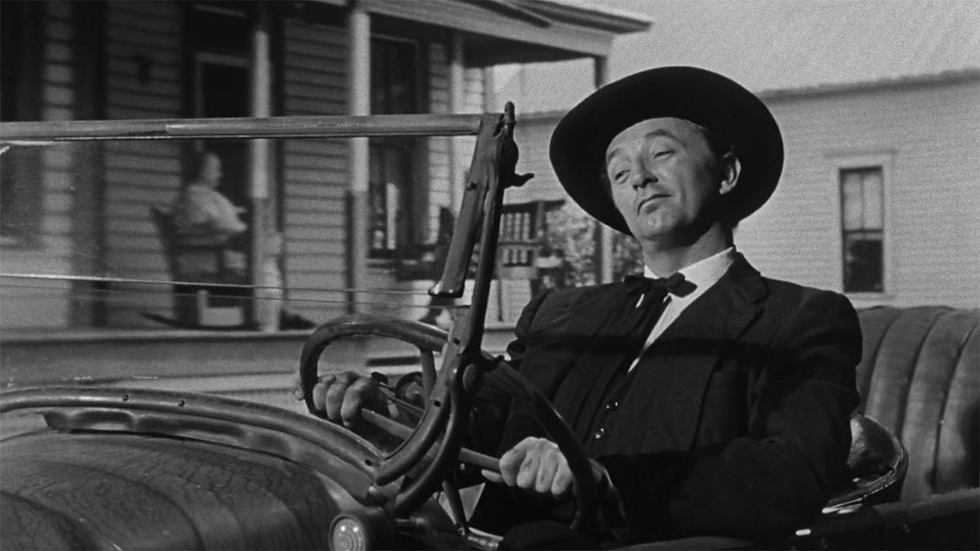
This peculiar relationship with God is among the most revealing elements of Mitchum’s performance. Powell addresses the Almighty with extraordinary familiarity, speaking as though the two are associates discussing unfinished business. His conversations are absurd precisely because their manner is so relaxed and their implications so appalling. Murder becomes a matter to be reported, accounted for and perhaps excused within a spiritual arrangement that never requires the other party to answer. There is a grimly comic resemblance between these monologues and the complaints of a travelling salesman frustrated by the inconveniences of his trade. Powell needs no congregation to validate the arrangement because he has appointed himself its sole interpreter. Yet the film never establishes that he hears a divine voice or receives supernatural instructions. His assertions belong to his character, not to the film’s demonstrated reality. To treat them as evidence of demonic possession or a particular psychiatric condition would diminish their dramatic function. Powell’s religious self-authorization is frightening enough without an invented explanation for its origins.
The burlesque-theatre sequence strips this self-authorization of its dignity. A performer dances before an audience, while Powell responds with visible agitation and the involuntary opening of his switchblade. The knife breaks through his clothing in an image that makes the connection between sexual repression and threatened violence difficult to overlook. The effect is simultaneously obscene, ridiculous and dangerous. Laughton does not need a confession of desire from Powell because the character’s physical behaviour contradicts his declarations of purity. Mitchum’s bodily discomfort becomes an argument against his supposed authority over the desires of others. What makes the scene particularly effective is its refusal to separate horror from comedy. The knife is an unmistakable threat, but its sudden appearance also humiliates the man who imagines himself morally superior to the woman he watches. Powell cannot govern the conflict within his own body, yet intends to govern the behaviour and conscience of an entire household. His hatred of perceived temptation thus becomes inseparable from the pleasure he takes in condemning it. The film is not asking the audience to excuse his violence as the inevitable consequence of frustrated sexuality; it exposes the hypocrisy through which he grants violent impulses the outward appearance of moral discipline.
A Town Prepared to Believe
The community Powell enters already possesses an extensive vocabulary for explaining the faults of women, the responsibilities of mothers and the necessity of respectable marriage. Icey Spoon, portrayed by Evelyn Varden, is especially important because she expresses those assumptions without recognising their cruelty. Her confidence is not the same as Powell’s calculated deception; she appears genuinely persuaded that her judgments reflect ordinary wisdom. That sincerity makes her a more troubling figure than a conscious accomplice. Icey sees the widowed Willa Harper as someone whose circumstances can be corrected by the arrival of a suitable husband, and Powell provides the outward characteristics such a solution requires. He has religious language, a commanding manner and the appearance of a man prepared to assume authority over a fatherless household. What Icey does not possess is reliable evidence of his character. Her certainty is supplied by social convention rather than investigation. Through her, the film suggests that a community need not be unusually foolish to become dangerous. It is enough for the community to mistake its prejudices for common sense.

The Depression setting gives this arrangement material consequences. Poverty has already placed the Harper family under extraordinary pressure, and Ben’s attempt to obtain money has ended in catastrophe. Willa is left with two children, a dead husband whose crimes have damaged the family’s standing and a future in which economic security appears uncertain. Powell’s arrival therefore offers more than the possibility of romantic companionship. He represents a socially recognisable structure in which a husband governs the household, religious authority promises moral reassurance and a vulnerable family might be restored to respectability. The strength of that expectation helps explain why John's distrust is so inconvenient to the adults around him. If the child is right, their reassuring picture of family life is false. If Powell is right, the community can continue believing that proper appearances reflect proper conduct. The adults therefore have reasons, some emotional and some ideological, to prefer the preacher’s version of events. Laughton makes their mistake more unsettling by allowing the same people to behave conventionally rather than monstrously in other circumstances. Evil does not need to transform the whole town into a collection of villains; it needs respectable assumptions to remain unexamined.
Powell’s success also depends on understanding the social value of being regarded as an outsider with exceptional spiritual credentials. A stranger ordinarily lacks the shared history through which a community evaluates its members, yet Powell turns that absence into an advantage. His unknown past can be filled with whatever virtues his listeners expect from a travelling preacher. Religious performance supplies a substitute biography, while confident speech discourages questions that might reveal inconsistency. He requires people to take the role he performs as evidence of the person he must be. John, however, has no particular investment in the stranger’s public reputation. He encounters Powell first as a threat to the fragile arrangements that keep Pearl and their father's secret safe. His judgment is consequently more attentive to behaviour than status, although his understanding remains shaped by childhood fear and an impossible responsibility. Powell repeatedly attempts to make John's suspicion appear like disobedience, placing the boy at a disadvantage within the household's hierarchy. The conflict exposes the violence hidden in a familiar demand: a child must respect the authority of an adult even when the adult has done nothing to deserve respect. Under those circumstances, obedience ceases to be a virtue and becomes a means by which danger enters the home.
Willa Harper and the Manufacture of Guilt
Willa’s marriage to Powell is among the film’s most disturbing developments because the violence against her begins before her murder. Shelley Winters portrays a woman already burdened by deprivation, widowhood and a painful uncertainty about her own moral worth. Powell discovers that her hunger for respectability can be redirected into a demand for submission. On their wedding night, his rejection of marital intimacy becomes an accusation against her desires rather than an admission of his own hostility. The setting should mark the beginning of a secure domestic relationship, but instead becomes a place where Willa learns to regard ordinary affection as a source of shame. Powell claims the authority to define what purity requires, while avoiding the reciprocal obligations of a husband. She is made responsible for the supposed impurity of desires he finds intolerable. The cruelty is especially effective because it allows her to participate in the language of her own degradation. She comes to describe herself through standards he controls, losing confidence in the legitimacy of her own needs. The marriage becomes a moral tribunal in which the accused must continually seek approval from the person who has already decided her guilt.

A subsequent revival sequence makes this private domination public. Willa's declarations of spiritual cleansing are presented within a religious gathering that encourages her to reinterpret the failures of her marriage and family as evidence of personal sin. The scene is disturbing not because public repentance is inherently fraudulent, but because the terms of her repentance have been imposed by a man who benefits from her diminished independence. She has accepted an explanation of suffering that redirects responsibility away from Powell and toward herself. The surrounding congregation gives this explanation a form of social confirmation, turning an abusive private arrangement into an apparent moral achievement. Willa’s exposed vulnerability is thus incorporated into the preacher's authority rather than recognised as evidence against it. Michael Sragow's 2010 Criterion essay is particularly valuable here because it resists treating her entirely as a passive simpleton. He observes that Willa learns Powell's interest in the missing money yet continues to regard him as a possible instrument of her salvation. Her tragedy lies partly in the persistence of that belief when contrary evidence has begun to emerge. Laughton’s film makes room for this contradiction without suggesting that her misplaced trust justifies her fate.
The discovery of Willa’s body supplies one of the most astonishing images in American cinema, but its beauty raises an ethical difficulty that should not be ignored. Her corpse remains submerged inside a car beneath the river, her hair and clothing moving gently in the water. The violence of her death is withheld from direct spectacle, while its aftermath is arranged into an image of almost unbearable stillness. Cinematographer Stanley Cortez and art director Hilyard Brown transform a scene of concealment into a composition resembling a submerged memorial. The result is visually magnificent, though the transformation of a murdered woman into an object of extraordinary pictorial beauty risks distancing viewers from the brutality inflicted upon her. That risk belongs to the scene’s meaning rather than necessarily constituting a failure of taste. Powell has attempted to remove Willa from both the household and the story, but the film grants her disappearance an image that cannot easily be forgotten. The spectacle of her body also demonstrates how thoroughly the murderer controls public knowledge of what has happened. The river contains the evidence while the town remains vulnerable to his explanations. What is visible to the spectator has not yet become usable knowledge for the people who could intervene.
Francine Prose, writing for the Library of America in 2016, offers a valuable production account of the underwater sequence through Jeffrey Couchman’s research. She describes the use of a wax figure, a submerged car, artificial lighting and a carefully constructed underwater environment to produce the scene's spectral appearance. These details matter because the image is not an accidental product of location photography or the passive recording of a realistic landscape. It is an elaborately manufactured vision of what violence leaves behind. Laughton’s artifice invites a question about the relationship between cinematic beauty and moral understanding. The spectator can admire the composition while recognising that the victim has been deprived of the power to narrate her own death. That tension should prevent the image from becoming merely decorative in discussions of the film's visual style. Willa has already been silenced within her marriage; after death, her body becomes the means through which another silence is rendered visible. Even the beauty of the scene cannot restore what has been taken from her. Its real accomplishment is to make absence impossible to overlook.
The Child Who Must Know Too Much
John Harper is frequently described as the child who sees through Powell, but this formulation risks making his perception seem effortless. Billy Chapin’s performance presents a boy whose suspicion grows within circumstances that have forced him into responsibilities no child should carry. His father has demanded secrecy concerning stolen money and has placed Pearl's safety in his hands. The promise becomes a burden whose moral complexity the adults around him are poorly equipped to understand. John must protect his sister while withholding information that might allow trustworthy adults to help them. He therefore experiences the world through a contradiction: secrecy is both an obligation imposed by his father and a source of danger exploited by his stepfather. His apparent wisdom is inseparable from his fear of betraying the dead. The boy's refusal to trust Powell is justified, but his predicament cannot be reduced to the triumph of childish intuition over adult ignorance. He is surviving within a world in which legitimate authority has already failed him. Laughton allows his fear to become a form of perception without pretending that fear constitutes freedom.

Pearl’s relationship with Powell creates a different difficulty. Sally Jane Bruce plays a younger child for whom the categories of danger, affection, fatherhood and authority have not yet become stable. Powell can offer the gestures of paternal attention without having to withstand the scrutiny John directs toward him. The contrast between the children is consequently more revealing than a simple division between intelligence and innocence. Pearl’s openness arises partly from her age and her desire for adult security, while John’s suspicion has been sharpened by knowledge he would rather not possess. The stolen money, concealed inside Pearl's doll, gives material form to the contradiction that governs their relationship. An object associated with comfort and childhood becomes the hiding place of the adult world's corruption. John must protect both the doll and the secret it contains, even when those duties place him in conflict with Pearl herself. Powell understands that the children's unequal knowledge can be manipulated, and he shifts his approach accordingly. His pursuit of the money becomes a struggle over the meaning of protection: whether an adult's authority deserves obedience or must be resisted to preserve a child's safety.
Laughton expresses the preacher's presence through spatial relationships that are more suggestive than continuous displays of physical violence. One of the film's most memorable images places Powell on horseback at a great distance, reduced to a dark silhouette against the horizon while John watches from a barn loft. The man has scarcely any visible facial expression at that distance, yet he remains unmistakable. His identity is supplied by posture, movement, the surrounding darkness and the recurring sound of his hymn. Space does not make him harmless; it converts distance into an opportunity for anticipation. The viewer understands that he is approaching even when he appears almost impossibly far away. David Thomson, in an essay originally published in Sight and Sound in April 1999, compares the image to the graphic simplicity of silhouette animation. That observation helps explain why the scene does not depend on realistic proportions or a detailed account of Powell’s journey. His appearance belongs to the logic of a child's nightmare, in which threatening figures can seem both remote and inescapable. The composition gives John's apprehension visual authority while preserving the knowledge that a real man, not a supernatural creature, is responsible for the terror.
The preacher's shadow produces a related effect when his presence invades the children's domestic space. A home should offer recognisable boundaries between the protected interior and the threatening world outside, but Laughton makes those boundaries unreliable. The enlargement of Powell's form across a wall turns a physical body into an image of disproportionate power. What frightens is not simply the figure's size, but the ease with which his identity can occupy a room before he physically enters it. The shadow contains none of the features ordinarily used to assess character, leaving only an outline of authority and threat. This is a visual reversal of the preacher's social method. In public, Powell supplies reassuring detail through clothing, religious rhetoric and controlled gestures; in the children's world, those details fall away, leaving the menace that his performance conceals. The film thus grants children a kind of visual knowledge unavailable to the trusting community. Yet their recognition does not immediately deliver them from danger. Knowing what Powell is cannot by itself overcome the institutional power adults have already granted him.
The River Beyond the Reach of the Preacher
John and Pearl's escape down the river alters the film's formal language without ending their vulnerability. Their small boat enters a landscape filled with large animals, dense vegetation, dark water and a sky whose scale makes human affairs seem temporarily insignificant. The compositions do not abandon fear so much as remove it from the immediate spectacle of the pursuing man. Animals appear at the edges of the journey, sometimes in exaggerated proximity to the camera, producing the impression that the children's passage is being observed by another order of life. The river offers movement when the social world has become impassable. It carries the children away from Powell without granting them control over where they will arrive. Walter Schumann's music and the film's use of children's song contribute to a mood that fluctuates between lullaby, dream and precarious refuge. The sequence is sometimes described as an escape into innocence, but that description requires qualification. The children have not recovered an innocent condition; they are experiencing temporary relief from a system of adult power that has endangered them. Their surroundings remain indifferent to whether they survive.
The images of the river draw upon a recognisable language of biblical deliverance and American childhood adventure. Francine Prose connects the journey to the story of Moses, while Michael Sragow emphasises how song and natural imagery create an atmosphere of enchantment without granting the children a true paradise. Both interpretations help illuminate the film's artistic method, though neither exhausts the sequence. Its visual beauty does not prove that nature is morally benevolent, just as Powell's religious appearance never proves that he is good. The boat moves within a world that offers shelter only intermittently, and the children remain dependent upon circumstances they cannot command. Their passage therefore offers a temporary suspension of human cruelty rather than a final moral solution. The significance of the river is also shaped by what has happened to Willa beneath its surface. The same water that conceals the mother's murdered body carries her children toward the possibility of protection. Laughton places destruction and deliverance within a single landscape, refusing to make the river an uncomplicated symbol of purification. The geography of the escape preserves the tragedy from which it begins.

The failure of Uncle Birdie Steptoe further complicates the prospect of rescue. Birdie, played by James Gleason, is one of the few adults with whom John has established a meaningful personal connection. His affection is genuine, and his vulnerability cannot be equated with Powell's calculated cruelty. Nevertheless, his retreat into alcohol leaves him unable to provide the help the children need at the decisive moment. This distinction between intention and capacity becomes essential to the film's moral structure. Not every failure of adult protection originates in malice, and not every affectionate adult can offer safety. Birdie's paralysis reveals a social world in which kindness may exist without the courage or resources required to make it effective. Powell exploits a similar gap at the opposite extreme, possessing confidence and practical determination without compassion. The children must eventually find someone who combines moral perception with an ability to act. Their destination matters because the film has repeatedly demonstrated that recognising suffering, expressing concern and possessing respectable intentions are insufficient unless those qualities produce protection.
Rachel Cooper and the Difference Between Faith and Authority
Rachel Cooper enters the story with a religious vocabulary no less confident than Powell's, but she applies it to different ends. The distinction cannot be established simply by declaring her sincere and him fraudulent, because sincerity alone would not protect children from a sincere fanatic. Rachel's character is demonstrated through conduct: she houses vulnerable children, attends to their needs, recognises manipulation and refuses to surrender them without trustworthy grounds. Her spiritual authority is inseparable from responsibilities she has voluntarily accepted. Where Powell uses the language of salvation to acquire control, Rachel treats faith as an obligation to defend people over whom she has no proprietary claim. She is capable of severity, and her resistance is not sentimental. The presence of a firearm in her care reflects an understanding that compassion sometimes requires the practical refusal of another person's demands. She does not need the preacher's approval to exercise judgment. Nor does she mistake his assertion of fatherhood for proof that he has the right to take John and Pearl away. Laughton finally places before Powell a person who recognises authority as something that must be answerable to the welfare of others.

Their nighttime confrontation brings the difference into unusually concentrated form. Powell waits outside Rachel’s house and sings the hymn Leaning on the Everlasting Arms, the same melody that has repeatedly accompanied his pursuit of the children. Rachel, keeping watch with her gun, joins in the singing rather than allowing him exclusive possession of the religious language. The sequence is remarkable because it converts a song associated with predatory persistence into a shared form that neither character can completely control. Their voices briefly occupy the same spiritual tradition while their actions reveal radically opposed moral commitments. The distinction is not achieved through a change of vocabulary, costume or denomination. It appears in the fact that one person is threatening the household while the other is protecting it. Peter Rainer, writing in an essay reproduced by the Library of Congress, draws attention to the complexity of Rachel joining Powell in the hymn despite her recognition of his evil. Their shared music complicates any reading in which the film simply locates goodness in one religious identity and evil in another. Faith becomes morally intelligible through what its adherents do when someone vulnerable stands before them.
Rachel's protection is also complicated by the presence of Ruby, the adolescent under her care who seeks affection in ways the older woman considers dangerous. Ruby's circumstances expose the limitations of a purely idealised picture of female virtue, particularly in a film otherwise inclined to associate sexual vulnerability with danger. Rachel can correct and shelter the girl without reducing her to a moral failure, although her guidance remains shaped by the expectations of an older generation. The contrast with Powell is significant because both adults judge behaviour, but only one consistently preserves the young person's claim to affection and protection. This is not a complete liberation from the film's conservative assumptions about sexuality. Willa's fate and Ruby's treatment still invite criticism of the way female desire is represented as a source of exposure to predatory men. Rachel nevertheless offers an alternative to the conviction that shame must be the foundation of moral discipline. Her care gives the children a place in which disclosure does not necessarily lead to punishment. Powell's authority depends upon making people ashamed of their needs, while Rachel's becomes meaningful when she responds to those needs without surrendering her judgment. Their opposition is therefore less a competition between rival preachers than a disagreement about what moral responsibility requires.
The Limits of a Fairy-Tale Victory
It would be too convenient, however, to regard Rachel as the complete solution to the society Powell has exploited. David Thomson's essay in Sight and Sound raises a serious objection: once the children reach her household, the story's terror may lose some of its force because their protector appears so secure in her goodness. Rachel is nearly the ideal adult a frightened child might invent, combining practical courage, moral confidence and a capacity to understand danger without being corrupted by it. The criticism deserves attention because the film's visual and ethical design is often more complicated than its final opposition between guardian and predator. Powell's theatrical excesses eventually threaten to make him resemble a storybook monster whose defeat is inevitable. The preacher who previously controlled a household through psychological manipulation becomes increasingly exposed as a figure of blustering inadequacy. Terrence Rafferty regards this comic dismantling as one of the film's most original achievements, while Thomson finds the resulting confrontation less troubling than the earlier world of unreliable adults. Both positions account for genuine features of the film. The disagreement concerns whether the movement from uncertainty toward fable constitutes a dramatic retreat or the fulfilment of Laughton's chosen form. The answer depends on whether the apparent simplicity of Rachel's goodness is understood as a realistic solution or as a deliberate image of the protection the children have been denied.

The preacher's arrest does not produce an uncomplicated restoration of order. When police apprehend Powell, John responds to the sight in a manner that recalls the earlier arrest of his father. The repetition transforms what might have served as an ordinary moment of punishment into a painful return of traumatic memory. John releases the money concealed in Pearl's doll, and the wealth around which the entire conflict has revolved loses its promised significance. It has not protected the family, redeemed the father's actions or supplied the security the children needed. Instead, it has become the material object around which adults have organised secrecy, violence and obligation. The film's repetition of the arrest suggests that a child's experience cannot be divided neatly between the capture of a guilty man and the capture of an innocent father, since Ben himself committed a serious crime. What remains in John's memory is the spectacle of authority taking someone away. The boy's suffering resists the clean separation between good and evil that other aspects of the narrative encourage. Even when the community finally recognises Powell as a murderer, recognition arrives too late to undo the damage caused by its earlier certainty.
The subsequent hostility directed toward Powell offers another revealing image of collective judgment. People who were previously willing to accept the preacher's apparent virtue become eager to condemn him once his criminal identity is publicly established. Their anger is understandable, but the speed of the reversal should not be confused with the acquisition of moral wisdom. The same habits of immediate certainty that once protected Powell now contribute to the appetite for public punishment. Icey Spoon's transformation is particularly important because her confidence survives the collapse of the beliefs she had defended. The authority of the crowd changes its object without necessarily changing its method of reaching conclusions. This is among the film's most unsettling observations about communal morality. A society capable of venerating an impostor may also be capable of becoming a mob when its admiration turns to rage. The discovery of guilt does not automatically produce a more responsible form of judgment. Powell's exposure removes the immediate predator, but the habits that enabled his authority may remain available to another one.
The Novel, the Film and the Historical Shadow
Davis Grubb's 1953 novel provides an indispensable distinction between Powell as a literary figure and Powell as a cinematic performance. The film preserves the central pursuit, the threatened children, the stolen money and the opposition between the preacher and Rachel, but the movement from prose to screen changes the character's expressive possibilities. Thomson identifies passages in Grubb's novel that give Powell a disturbing inwardness less conspicuous in Mitchum's expansive interpretation. In the novel, the character can inhabit private states that prose describes without requiring them to become theatrical gestures. Mitchum's Powell, by contrast, often seems incapable of leaving an impulse unperformed. His voice, hands, posture and sudden eruptions of indignation convert inward corruption into public spectacle. This does not necessarily make the film's character psychologically shallower, although it removes some of the novel's particular ambiguity. Laughton's version depends upon the audience observing how thoroughly a fraudulent moral performance can occupy the physical world. The difference is therefore not simply one of omitted literary detail. It involves a change in emphasis from the mysterious interior of the predator to the social consequences of his outward behaviour.

The adaptation's authorship also requires more care than the familiar anecdote about James Agee producing an unusably long screenplay and Laughton rescuing the project single-handedly. Michael Sragow's research-based Criterion essay challenges that simplified account, noting the importance of Agee's surviving draft and the continuity between its inventions and the completed film. Francine Prose likewise draws upon Jeffrey Couchman's production history to describe extensive revisions without dismissing Agee's contribution. These accounts complicate older claims that the credited screenwriter provided relatively little of value. The visual structure of the final film undoubtedly bears Laughton's directorial authorship, but its language, dramatic incidents and relationships cannot responsibly be attributed to him alone. Grubb's illustrations and correspondence further demonstrate that the novelist contributed ideas capable of influencing the film's visual conception. The completed work is best understood as the result of intersecting artistic decisions rather than the expression of a single unchallenged authorial intention. That recognition matters when interpreting Powell because some of the character's most memorable features arise from the relationship between Grubb's prose, Agee's dramatic construction, Mitchum's performance and Laughton's visual organisation. The character becomes distinctive precisely where those different forms of authorship converge.
The documented historical connection to Harry Powers must be treated with equal precision. Powers was a real murderer whose crimes became notorious in West Virginia in 1931, involving women he contacted through correspondence and victims whose trust he exploited for financial gain. He was convicted of the murder of Dorothy Lemke and executed at the West Virginia Penitentiary in March 1932. West Virginia University's archival collections establish that Grubb identified the Quiet Dell murders as an inspiration for his novel. They do not establish that every important characteristic of the fictional preacher originated with Powers, nor that Powell's religious performance accurately reconstructs the historical man's behaviour. The difference is substantial because fiction can transform documented events into an argument about social institutions without functioning as a historical reenactment. The similarity between the names Harry Powers and Harry Powell is suggestive, but the archive provides stronger evidence of influence than the names alone could supply. Grubb's annotated copy also identifies his own childhood experiences in West Virginia and a remembered individual associated with Rachel as creative sources. Powell therefore belongs to an imaginative world shaped by crime, geography, memory and literary construction. Treating him as a thinly disguised portrait of Powers would obscure the work that adaptation performs.
What the Preacher Leaves Behind
The achievement of Mitchum's Powell lies in the distance between the frightening simplicity of his appearance and the complicated social conditions that make him effective. He is memorable as a figure in black, a singer in the distance, a knife-bearing stranger and a man whose fingers bear opposing moral declarations. Each of those characteristics belongs to the language of fable, where good and evil can appear in forms readily understood by children. Yet the world through which he moves is not governed by similarly transparent judgments. Willa's desire for salvation becomes a means of controlling her, Icey's confidence gives prejudice the appearance of wisdom, and John's justified suspicion leaves him isolated among adults who value obedience. Rachel ultimately defeats the preacher not by possessing a more impressive religious performance, but by acting upon the difference between credible evidence and asserted authority. Her victory does not suggest that faith must be abandoned in order to resist exploitation. It suggests that professed faith becomes dangerous when exempted from moral examination. The distinction remains important because Powell does not invent every value he uses; he borrows familiar language and demonstrates how violently it can be turned against the people it claims to protect. His evil is personal, but its temporary success is social.

What remains after Powell's capture is not the comfort of believing that the world has become safe. John and Pearl have survived experiences that cannot be erased by the warmth of Rachel's household or the celebration of Christmas. The film nevertheless insists that survival matters and that care can be made visible through ordinary acts rather than spectacular declarations. Rachel's closing affirmation that children endure should be heard alongside the evidence of what endurance has cost them. It is both a declaration of admiration and an admission that the world asks far too much of those least able to defend themselves. This is why the contrast between Powell and Rachel survives the limitations of its fairy-tale form. One character possesses the symbols of goodness and uses them to justify his desires; the other demonstrates goodness in the difficult work of refusing those desires when they threaten someone vulnerable. The preacher's hands promise that love will triumph because he can arrange the contest to make it so. The film offers a more demanding proposition: love acquires moral force only when it accepts responsibility for another person's safety. Harry Powell remains frightening not because he successfully disguises evil as goodness, but because he reveals how little evidence people sometimes require before believing they have recognised the difference.
Selected Bibliography and Verified Research Sources
Primary and archival material
Laughton, Charles, director. The Night of the Hunter. Paul Gregory Productions / United Artists, 1955. Screenplay credited to James Agee, adapted from Davis Grubb's novel. Film documentation and restoration details: The Criterion Collection.
Grubb, Davis. The Night of the Hunter. Harper & Brothers, 1953. Original novel. Its bibliographic identity and selected passages were checked against secondary film scholarship; the complete novel was not independently examined for this article.
West Virginia and Regional History Center, West Virginia University. Davis Grubb, The Night of the Hunter (Annotated Copy), collection A&M 0252, dated 1977. Archival finding aid.
West Virginia University Libraries. “The Harry Powers Murders: Crimes That Inspired West Virginia Authors.” October 28, 2014. WVU Libraries.
Film scholarship and criticism
Rafferty, Terrence. “The Night of the Hunter: Holy Terror.” The Criterion Collection, November 16, 2010. Read essay.
Sragow, Michael. “Downriver and Heavenward with James Agee.” The Criterion Collection, November 18, 2010. Read essay.
Prose, Francine. “The Primal Pull of Charles Laughton’s The Night of the Hunter.” Library of America, October 6, 2016. Read essay. See also Criterion's shorter June 1, 2016 piece, “Francine Prose on the Loaded Imagery of The Night of the Hunter.”
Rainer, Peter. “The Night of the Hunter.” In The A List: The National Society of Film Critics’ 100 Essential Films, 2002. Reproduced by the Library of Congress, National Film Preservation Board. Read essay (PDF).
Thomson, David. “A Child’s Demon: Robert Mitchum in The Night of the Hunter.” Sight and Sound, originally April 1999; republished online July 24, 2025. Read essay.
Ehrenstein, David. “The Night of the Hunter.” The Criterion Collection, February 1988. Read essay.
British Film Institute. “Film 6: The Night of the Hunter (1955).” Gothic: The Classroom educational resources, undated. BFI study material.
Kreiser, Christine M. “Harry Powers.” e-WV: The West Virginia Encyclopedia, revised February 9, 2024. Historical entry.
Editorial Research Notes and Contested Claims
Primary-film verification: The film's documented narrative, scenes and visual motifs were cross-checked against specialist criticism and institutional descriptions, but this investigation does not claim an independent, uninterrupted viewing of the complete restored film. Exact shot order, scene timing and fine-grained audiovisual observations should be checked against the licensed film before publication.
Grubb's novel: The 1953 publication date is established, and the comparison uses documented passages and scholarship. Because the complete original edition was not independently read, the essay avoids claims of exhaustive literary comparison.
Historical inspiration: West Virginia University provides archival evidence linking the novel to Harry Powers and the Quiet Dell murders. This establishes creative influence, not a comprehensive biographical correspondence between Powers and Powell.
Screenplay authorship: Older accounts of Laughton's rewriting sometimes minimise Agee's contribution. The surviving screenplay evidence discussed by Sragow and Prose supports a more collaborative account. The precise division of creative responsibility remains difficult to determine.
Interpretive disagreements: Thomson's objection to Rachel's apparent invulnerability is a significant counterreading, not a factual contradiction. Similarly, descriptions of Powell as demonic, pathological or allegorical should be treated as interpretive language unless a specific claim is independently established.
Critical originality: This dossier's central distinction between religious performance, social credibility and the ethical testing of authority is its editorial argument. It does not claim that previous criticism has ignored the relationship between faith and communal complicity.
Image Credits & Sources
All images accompanying this article are authentic photographic materials associated with Charles Laughton's The Night of the Hunter (1955), produced by Paul Gregory Productions and distributed by United Artists. No AI-generated or reconstructed imagery has been used.
The links below document where each image was located for editorial research. They do not, in themselves, constitute permission to reproduce the images. Image licensing, original rights ownership, and any required credit language must be confirmed before publication.
I-01 — Lead Image: Harry Powell and the LOVE/HATE Tattoos.The Night of the Hunter (1955). Image reproduced by Miradas de Cine.Source: https://miradasdecine.es/2002/04/la-noche-del-cazador-the-night-of-the-hunter-charles-laughton-1955.html
I-02 — Harry Powell's LOVE Tattoo.The Night of the Hunter (1955). Image reproduced by American Cinematographer / American Society of Cinematographers.Source: https://theasc.com/articles/flashback-the-night-of-the-hunter
I-03 — Harry Powell's Private Religious Monologue.The Night of the Hunter (1955). Film frame reproduced by Filmsite.Source: https://www.filmsite.org/dramas/nightofh.jpg
I-04 — Spoon's Establishment.The Night of the Hunter (1955). Film frame reproduced by Thais Castralli.Source: https://www.thaiscastralli.com/post/weekly-inspiration-the-night-of-the-hunter-1955
I-05 — Willa Harper's Submerged Body.The Night of the Hunter (1955). Film frame reproduced by SINephile.Source: https://www.sinephile.com/p/my-100-essential-films
I-06 — John Harper Watches the Distant Rider.The Night of the Hunter (1955). Film frame reproduced by All Things Thriller.Source: https://allthingsthriller.com/2018/08/27/the-night-of-the-hunter-a-film-directed-by-charles-laughton-1955-cinematography-by-stanley-cortez-fantasy-southern-gothic-film-noir/
I-07 — John and Pearl's River Escape.The Night of the Hunter (1955). Film frame reproduced by LiFO.Source: https://www.lifo.gr/culture/cinema/ena-megalo-kinimatografiko-kalokairi
I-08 — Rachel Cooper's Armed Vigil.The Night of the Hunter (1955). Film still reproduced by Gateway Film Center.Source: https://gatewayfilmcenter.org/movies/cult-101-the-night-of-the-hunter-1955/
I-09 — John Harper Reacts to the Preacher's Arrest.The Night of the Hunter (1955). Film frame reproduced by Filmsite.Source: https://www.filmsite.org/snaps/nightofh43.jpg
I-10 — Robert Mitchum During Production.The Night of the Hunter (1955). Archival production photograph. UCLA Film & Television Archive.Source: https://newsroom.ucla.edu/file?fid=5f616e9b2cfac252eee4fcdf
I-11 — Rachel Cooper and the Ethics of Care.The Night of the Hunter (1955). Film frame reproduced by Jay's Classic Movie Blog.Source: https://www.jaysclassicmovieblog.com/post/60-the-night-of-the-hunter-1955
Image Licensing and Rights Clearance
Primary rights inquiry: MGM Media Licensing, including the United Artists film library.Website: https://www.mgm.com/corporate/licensingMedia Library: https://clips.mgm.com/Email: clipstill@mgm.com
Any archival photograph supplied by a separate institution may be subject to additional photographer, collection, or reproduction rights. Written clearance should specify the permitted digital editorial use, territorial scope, duration, and required attribution.
Editorial status: Image selections and source references prepared. Publication rights pending verification and clearance.
Comments