After the Sheriff Left the Room: The Pascagoula Recording and the Limits of Sincere Testimony
In October 1973, two Mississippi shipyard workers told police that extraordinary beings had taken them aboard an unknown craft. A recording made after their questioning became the case's most persuasive artifact. Half a century of interviews, investigations, and documentary footage reveals why the distinction between a convincing witness and a verified event remains essential.

Black-and-white photograph of Charles Hickson seated beside a younger Calvin Parker, who sits with his arms crossed, during an October 1973 interview.
On the night of October 11, 1973, Charles Hickson and Calvin Parker entered the Jackson County Sheriff's Office in Pascagoula, Mississippi, with an account that the officers receiving it struggled to believe. The two shipyard workers said they had been fishing beside the Pascagoula River when a strange object descended nearby, releasing three figures that carried them into an enclosed craft. They described being immobilized, subjected to an examination, and returned to the riverbank before the object departed. Sheriff Fred Diamond and Captain Glenn Ryder questioned them, then left them alone in a room where a tape recorder continued running without their knowledge. The arrangement was intended to test whether their story might collapse in private. Instead, the recording preserved a conversation in which the men continued discussing the experience and Parker repeatedly expressed his desire to leave or seek medical attention. Those exchanges subsequently became one of the most frequently cited arguments for their credibility. Yet the circumstances that make the tape historically valuable do not establish that its speakers correctly identified the cause of their reported experience.
For Daily Strange, the Pascagoula case presents a question more demanding than whether the two men sounded convincing. What does testimony reveal when its speakers appear sincere, but the event they describe cannot be independently reconstructed? The surviving record extends well beyond the sheriff's office, encompassing early investigative bulletins, a published transcription, a university oral-history interview, local reporting, later witness accounts, and a documentary distributed during Hickson's lifetime. These sources were produced under different conditions, for different audiences, and at different distances from the original report. Some preserve statements made within days, while others document recollections shaped by decades of publicity and personal interpretation. The distinction matters because an archival recording is evidence of a conversation, a documentary is evidence of a particular presentation, and a remembered experience is evidence of what a person reports remembering. None can automatically perform the evidentiary function of the others. The challenge is to examine the relationship among them without turning uncertainty into either a supernatural verdict or an accusation of dishonesty.
The Riverbank Before the Recording
Hickson and Parker were not unrelated observers who happened to report similar experiences independently. They worked at F. B. Walker and Sons Shipyard, and Hickson had helped Parker obtain employment after the younger man arrived in the area. Parker was also staying with Hickson and his wife, giving their relationship a domestic dimension beyond the workplace. When they went fishing that evening, they shared an established familiarity that influenced how they communicated and responded to one another. Later interviews indicate that their recollections of the evening's ordinary movements were not identical, including details about where they initially attempted to fish. Such differences do not establish that the encounter was invented, since even witnesses to uncontroversial events may disagree about incidental circumstances. They do, however, prevent investigators from treating every common element in the men's accounts as independent corroboration. Their shared history is part of the evidence, rather than an inconvenient detail to be excluded from it.

Black-and-white archival photograph of Charles Hickson standing on a rough riverbank, with bridge spans and industrial structures across the water
In the version published from the early police interview, Hickson described noticing a blue light and an oblong object hovering close to the riverbank. He said three figures emerged, moved toward them, and lifted him aboard without conventional physical effort. He described their appearance through comparisons with familiar anatomy, including unusual heads, protrusions, and hands resembling pincers. Inside the reported craft, he recalled an object that seemed to move over his body during an examination, although he struggled to identify what it was. His account also contained significant limits: he could not confidently identify several physical features, could not provide a reliable measure of the time spent inside, and acknowledged uncertainty about portions of the experience. Parker supplied less of the initial interior narrative, partly because his early account emphasized losing consciousness or awareness. The details became familiar through newspapers and subsequent publications, but their repetition does not convert them into independently observed physical facts. What is documented is that the men reported these experiences, not that the craft or its occupants were established by external evidence.

Aged newspaper clipping with a large headline about Pascagoula men reporting that they were taken aboard a UFO.
The decision to report the incident also had a history before the sheriff's office interview began. Hickson's account, as reproduced by Ralph and Judy Blum in their 1974 book Beyond Earth, described an unsuccessful effort to reach a newspaper reporter and an attempted telephone contact with Keesler Air Force Base. His sequence of contacts is relevant, though the accessible materials do not independently establish every institutional response. The men had already talked about what to do, and they later acknowledged different preferences concerning publicity. Parker wanted to avoid public attention, while Hickson came to believe that officials needed to hear the account. Hickson also told the police he had consumed alcohol after the alleged incident to settle himself, a detail that must be distinguished from unsupported claims that either man was intoxicated when the encounter reportedly occurred. By the time the officers questioned them, the story had already been considered, discussed, and at least partly repeated. The sheriff's office therefore captured an unusually early account, but not an entirely untouched first recollection.
A Conversation Recorded Without Its Intended Audience
The officers' recording tactic was based on a practical expectation about deception. Ryder later recalled that he and Diamond suspected the men might admit to fabricating the story once the questioning stopped and the investigators departed. Instead, the published excerpts show Parker discussing his inability to settle down, his apparent loss of consciousness, and his desire to obtain medical attention. Hickson responded with attempts to reassure him and continued referring to the reported encounter as something they had experienced. The exchanges were less formally organized than the preceding interrogation, with the men shifting between physical reactions, fragments of remembered events, and concern about whether others would believe them. Because they did not know the recorder remained active, they were not responding to questions consciously directed by the officers at that moment. That circumstance strengthens the recording's value as a source of spontaneous-seeming conversation. It does not eliminate the possibility that the speakers were influenced by what they already believed, what they had told each other, or how they expected the experience to affect their lives.
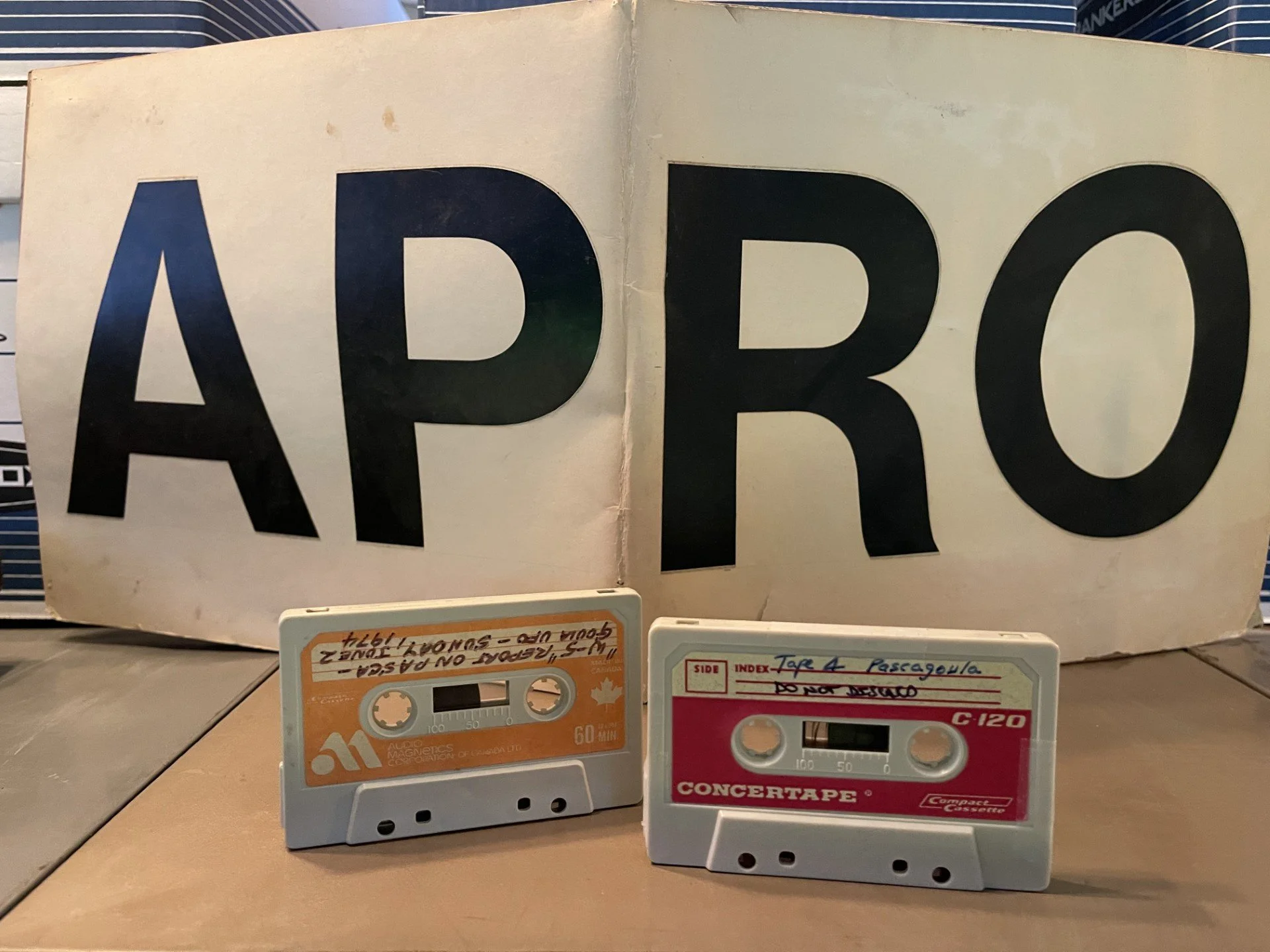
Two labeled audio cassettes displayed in front of large APRO lettering.
An important detail in the published dialogue complicates the familiar
distinction between an authentic private conversation and a supposedly rehearsed public story. Hickson continued explaining the encounter after the officers had departed, but his remarks also revealed that he already possessed an interpretation of unidentified aerial phenomena before October 11. He associated the experience with his belief that intelligent beings existed elsewhere, rather than arriving at that conclusion solely through the police interview. Parker, meanwhile, returned to the subject of passing out even after the direct questioning had ended. Their conversation was not a formal statement, yet it was also not free of concepts and explanations they had developed before entering the room. The men were trying to make sense of their own reported experience in language available to them. Their responses may be consistent with sincere conviction without determining whether that conviction arose from an accurately perceived external event. Treating the recording as a psychological snapshot is reasonable; treating it as an instrument capable of identifying extraterrestrial activity is not.
Two labeled compact audio cassettes positioned in front of a large APRO display, photographed as part of a later archival recovery.
The distinction becomes sharper when the recording's transmission history is considered. A later compilation associated with researcher Wendy Connors lists a sheriff's-office interview dated October 11, 1973, with a catalogue duration of 38 minutes and 30 seconds. That entry confirms the presence of an identifiable recording within a collection devoted to the Pascagoula case, alongside other historical interviews and broadcasts. It does not independently establish the precise running time, completeness, or condition of the original police master. The collection's hosting page describes the recordings as compiled and edited, making it important to distinguish the overall compilation process from any alteration of a particular track. A complete archival assessment would compare the physical or institutional master, intermediate copies, published transcripts, and modern digital files. It would identify omissions, damaged sections, transfer changes, and editorial additions before asserting that one available version reproduces the original session in full. Until that comparison is made, the recording's historical existence and the authentication of a particular public copy remain separate propositions.
What an Early Transcript Preserves—and Omits
Ralph and Judy Blum brought portions of the police interview to a wider readership in Beyond Earth: Man's Contact with UFOs, published in 1974. Their account described access to the recording and presented dialogue alongside the authors' own explanations of the setting and witnesses. A third-party reproduction of those pages allows examination of the selected exchanges, but it is not a certified transcript of the complete original recording. It also contains the authors' judgments about the men's apparent condition, their personal impressions, and the circumstances in which the material was heard. Readers must therefore distinguish the witnesses' reported words from narrative descriptions composed by people sympathetic to the experience's significance. In particular, the editors' impressions of vocal strain or distress cannot substitute for an independently conducted acoustic or psychological examination. Their publication remains valuable because it preserves an early textual version of the interview and the subsequent private conversation. Its limitations arise from the very process that made the material available: selection, transcription, commentary, and publication.
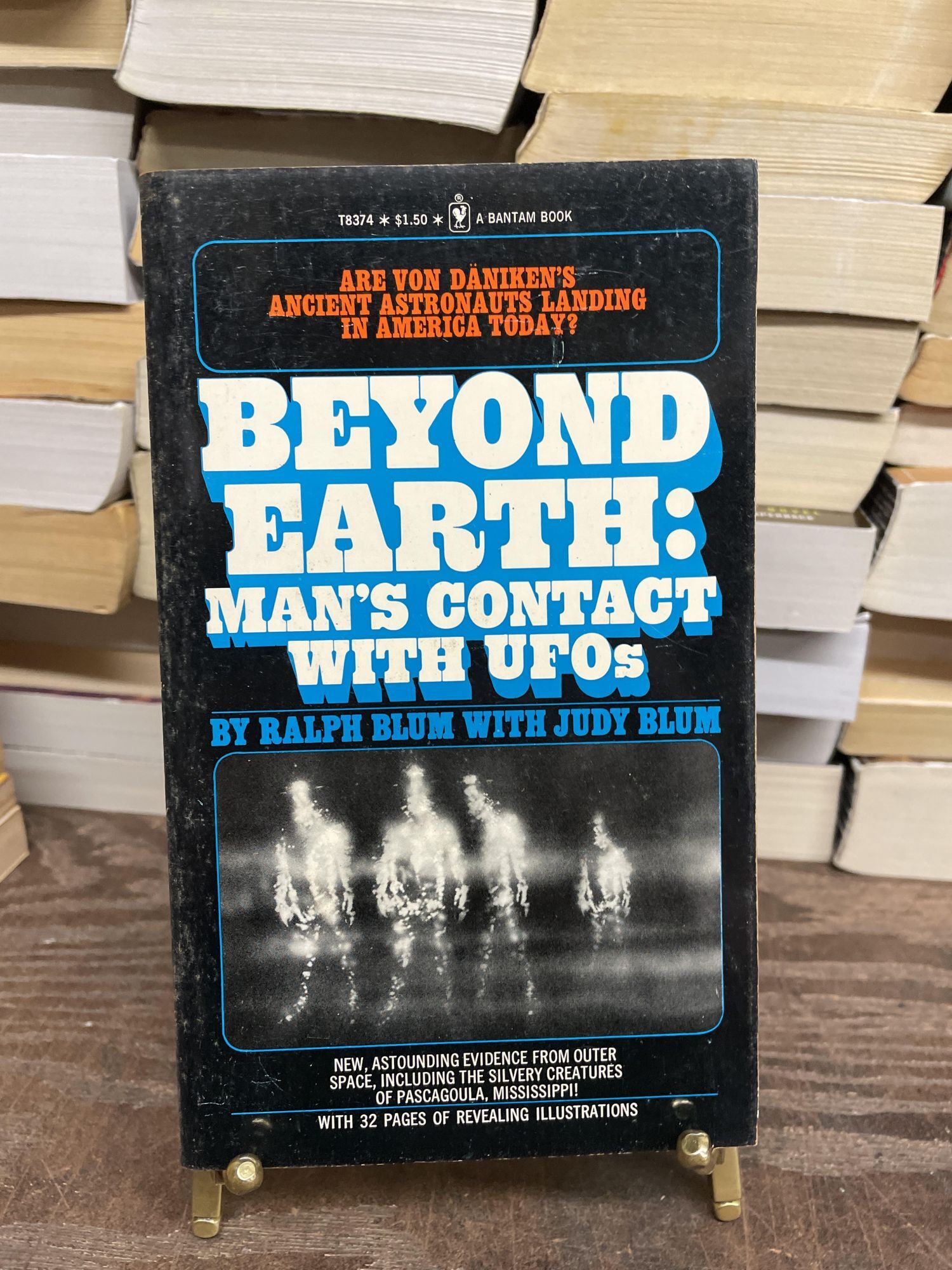
Worn black paperback cover with large blue and white Beyond Earth lettering.
The distinction is more than a technical archival precaution. A written dialogue cannot reproduce every property of a recording, including tone, overlapping speech, pauses, and the surrounding sounds that might affect interpretation. Conversely, a modern listener may hear details in an old recording differently after becoming familiar with a published narrative. If a transcript has silently omitted interruptions or uncertain passages, its apparent continuity may be the product of editorial decisions rather than the original conversation. The Blums' reproduction also places the reader in the hands of narrators who had already drawn strong conclusions about the event's emotional impact. Such judgments may be understandable without becoming independently verifiable facts. The appropriate historical method is to retain the identity of each source layer and avoid collapsing them into a single document. A recording, a transcript, and a literary account of listening to that recording are related artifacts, but they are not interchangeable.
The sheriff's-office conversation is particularly important because of what later testimony would say about Parker's reported loss of consciousness. In 2018, Parker told journalist Karen Nelson of the Sun Herald that he and Hickson had agreed to describe him as having passed out, allowing Hickson to provide the principal narrative. This was a significant retrospective acknowledgment of an intentional decision about what to tell investigators. Yet the published private exchange shows Parker continuing to refer to passing out even after the officers left the room. That does not necessarily refute his later explanation, since a person may continue using an agreed account in private, or may understand an episode differently over time. It does prevent investigators from assuming that his early description can be separated neatly into deliberate public presentation and completely different private recollection. The contradiction must remain visible rather than being resolved through an invented motive. The record supports the existence of different descriptions of Parker's awareness, while the reasons for those differences remain open to investigation.
The Investigators and the Questions They Brought
Interest in the case moved beyond local law enforcement almost immediately. The Aerial Phenomena Research Organization, or APRO, recorded receiving a report from a radio broadcast on the morning of October 12 and arranging for James A. Harder to travel to Pascagoula. Its September–October 1973 bulletin describes interviews, consultations, and attempts to obtain further details through hypnosis. The contemporary account is especially valuable because it preserves the investigators' procedures as well as their interpretations. Harder and other participants discussed earlier reported encounters, including those involving Betty and Barney Hill and Antonio Villas Boas, before portions of the later questioning. They also used hypnotic procedures and suggestions, including an effort intended to relieve Hickson's headache. Those details do not establish that the witnesses were deliberately influenced or that their memories became false. They do show that some subsequent descriptions were obtained in an investigative environment where comparisons with earlier UFO narratives had already been introduced.
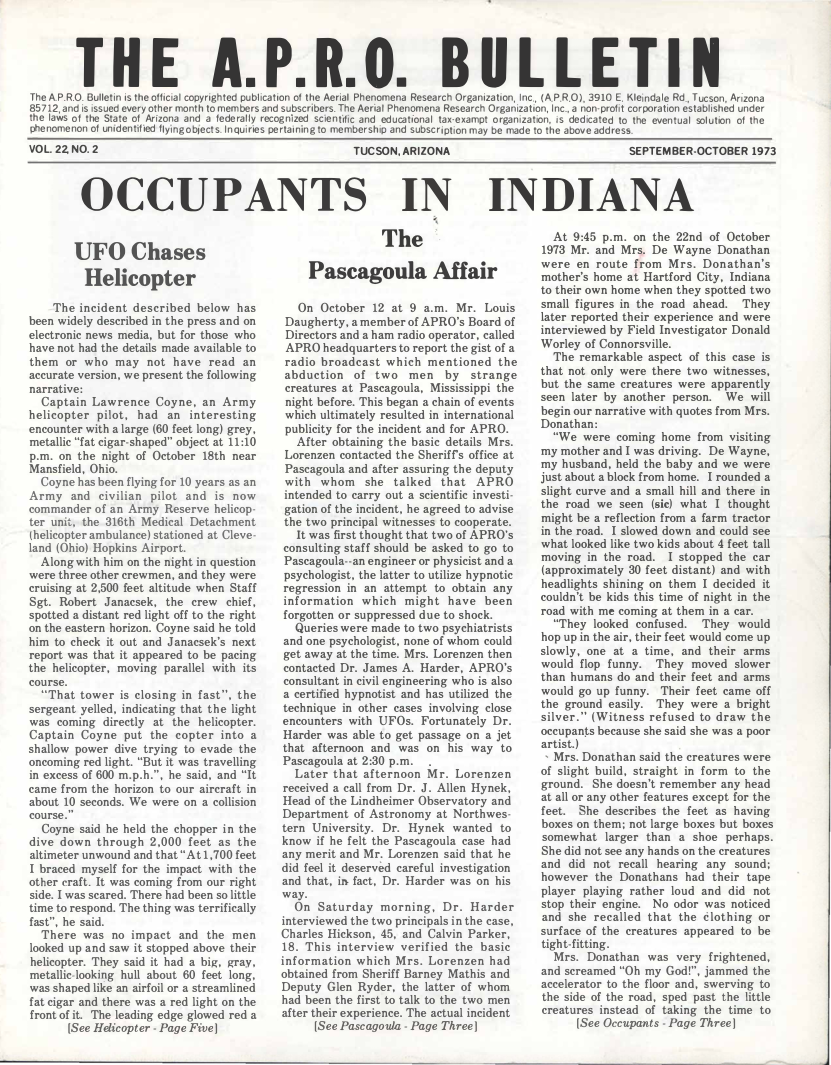
Scanned three-column APRO bulletin page headed “Pascagoula,” containing the investigators' account.


Black-and-white 1973 bulletin page containing two line drawings: a human figure flanked by two unusual figures and a separate full-length illustration of a wrinkled humanoid form.
APRO's report also reveals how confidently certain investigators interpreted behavior. Harder considered the men's reactions difficult to simulate and concluded that they had undergone an extraordinary experience. In its November–December follow-up, the organization referred to a prayer heard on the concealed recording and interpreted it as an indication of emotional strain. These judgments illuminate the investigators' expectations and the cultural assumptions underlying their assessment of sincerity. Prayer may reflect distress, belief, habit, or a deliberate appeal for help, but its presence cannot establish the physical origin of an event. Likewise, a person's apparent difficulty answering questions can be consistent with several explanations, including fear, uncertainty, exhaustion, and unusual subjective experience. The records show investigators trying to distinguish a convincing report from deliberate invention without possessing a dependable means of identifying the event's cause. Their confidence is part of the historical story, not an independently verified conclusion that later writers are obliged to adopt.

Black-and-white typeset page from a November 1973 UFO investigation newsletter.
The treatment of polygraph and voice-stress evidence presents a related problem. Contemporary publications reported testing connected with Hickson and described results interpreted favorably by investigators who already considered the case important. The November 1973 UFO Investigator, published by the National Investigations Committee on Aerial Phenomena, also acknowledged procedural limitations affecting efforts to evaluate the recorded interviews through voice-stress analysis. Such techniques were invoked to answer questions about truthfulness, although even a favorable interpretation could not establish that an unidentified craft existed. The National Research Council's later scientific assessment, The Polygraph and Lie Detection, explains that physiological responses can arise from conditions other than deception and that the accuracy of testing varies with procedure and context. A person convinced of an extraordinary experience may respond as a truthful speaker while remaining mistaken about what occurred. Conversely, a technical test's limitations do not prove that the person deliberately lied. The distinction between an assessment of responses and independent verification of an external event must remain intact. The Pascagoula tests belong to the history of the investigation, not to a completed scientific demonstration of the alleged encounter.
From a Police File to a Public Story
The Pascagoula account entered public culture with remarkable speed. The University of Southern Mississippi records that journalists were pursuing interviews within 24 hours and that Hickson's story reached the national television circuit. Within days, Reverend Bill Riddick of Ocean Springs Baptist Church had addressed the incident in a sermon delivered on October 14, 1973. His sermon, Visitors from Outer Space: What Saith the Lord?, was subsequently distributed on an LP record, and an example survives in the university's Special Collections holdings. The record sleeve illustrates the encounter through the visual language of the reported beings and craft, demonstrating how quickly the narrative acquired a recognizable public appearance. Its theological interpretation reflects a community responding to an unfamiliar claim through existing religious concerns. Neither the sermon nor the cover supplies evidence that the described beings were extraterrestrial, but both document the remarkable speed with which the case acquired meanings beyond the witnesses' original report. Pascagoula had become not merely a police investigation but an event people used to discuss fear, religious belief, authority, and the possibility of life elsewhere.

Color record sleeve with yellow title lettering against a dark background, showing a stylized spacecraft, several unusual figures, two human figures, and a wooden dock.
Public attention also changed the conditions under which the two men could remember and explain their experience. Hickson became the principal public narrator, participating in interviews and later writing about the encounter. Parker remained much more reluctant to engage with publicity, although his silence did not mean that the experience ceased to occupy his private life. The difference created an uneven archive in which Hickson's account was repeatedly recorded while Parker's more extensive personal descriptions circulated much later. That imbalance matters when researchers compare the stability of the two men's stories. A frequently repeated account may become consistent partly because its narrator has developed a settled way of telling it, while a less publicly rehearsed account may enter the record under different circumstances. Neither pattern is inherently evidence of truth or fabrication. The historical task is to identify when particular statements were recorded, whether their speakers had encountered earlier published material, and what opportunities existed for their interpretations to develop.

Black-and-white archival title page identifying the Mississippi Oral History Program, Volume CVIII, Charles Hickson, 1979, and interviewer Dr. Orley B. Caudill, with handwritten catalog notations near the top.
A more formal record of Hickson's later recollections was created in 1979, when Dr. Orley B. Caudill interviewed him for the Mississippi Oral History Program at the University of Southern Mississippi. A 2022 institutional description identifies the interview and explains that it covers both the reported encounter and the consequences of the attention that followed. Its summary includes Hickson's recollection of the object, his inability to communicate during the alleged examination, and the public appearances that became part of his life afterward. The archive offers an important point of comparison between the first police interview and the books or documentaries produced in later decades. It also demonstrates the value of an institution preserving an interview within a defined collection, with an identifiable narrator, interviewer, date, and archival location. The university's published description is not, however, equivalent to an examination of the complete transcript or audio. Its concise summary cannot establish every question Caudill asked or every detail Hickson supplied. The interview is therefore a substantial research resource whose full evidentiary potential depends on further examination of the original material.
In Contact: When the Witness Became a Documentary Subject
By the late 1990s, Hickson's account was circulating in a form that could combine his testimony with an audiovisual presentation of the case. The June 1998 issue of the MUFON UFO Journal included an interview with Hickson and an editorial notice advertising a VHS tape titled In Contact among materials available from him. This establishes that a production bearing the title was being distributed during his lifetime, rather than appearing solely as a recent internet upload. The University of Southern Mississippi's 2014 Pascagoula collection feature also links to a YouTube video titled In Contact: The Pascagoula UFO Abduction, placing that online item within a recognizable institutional research context. These references make the film relevant to the history of the case, even though they do not establish every aspect of the production's original credits or the completeness of the uploaded version. The distinction is important because a modern digital copy may differ from an earlier cassette in running time, editing, sound, or accompanying material. The available documentation permits the film to be identified as a historical source lead, not to be described through invented scenes or dialogue. Any close audiovisual analysis requires a documented viewing copy and a comparison with the original edition.

Blue-toned illustration showing part of an older man's portrait, a younger man, and a stylized humanoid figure.
The documentary's significance is different from that of the police recording. The sheriff's-office tape captured testimony close to the alleged encounter, under circumstances in which the witnesses believed the questioning had ended. A documentary associated with Hickson's later public activity belongs to a period in which the encounter had already acquired a substantial body of interpretation. By then, his personal narrative had moved through newspapers, investigators' reports, public appearances, and his 1983 book UFO Contact at Pascagoula, coauthored with William Mendez. The film's historical value lies in its place within that continuing presentation of the experience, rather than in an assumed ability to corroborate the reported event independently. Its audiovisual form potentially offers additional information about how testimony was delivered, edited, contextualized, and framed for an audience. Those possibilities should guide an actual viewing and comparison, not be substituted for one. In this sense, In Contact adds a new layer to the archive: evidence of an account's public evolution that must itself be subjected to documentary criticism.
Parker's Later Recollections
Parker's fuller account emerged into broader public view long after Hickson had established the narrative's familiar outline. Karen Nelson's 2018 Sun Herald reporting documented his explanation that the original loss-of-consciousness account had been agreed upon, rather than accurately representing everything he remembered. Parker also described the effect of publicity on his personal life, including his fear of being recognized and the interruption of ordinary plans. His eventual willingness to discuss the experience in detail therefore cannot be understood simply as the recovery of previously inaccessible information. It was also a decision to speak in a public environment that had changed substantially since 1973. His recollections were shaped by personal history, changing confidence about disclosure, and decades of exposure to accounts of the incident. These circumstances are relevant to source evaluation without providing a basis for diagnosing him or declaring that his memories were manufactured. A respectful analysis can recognize the consequences he described while examining the historical status of the details he later supplied.
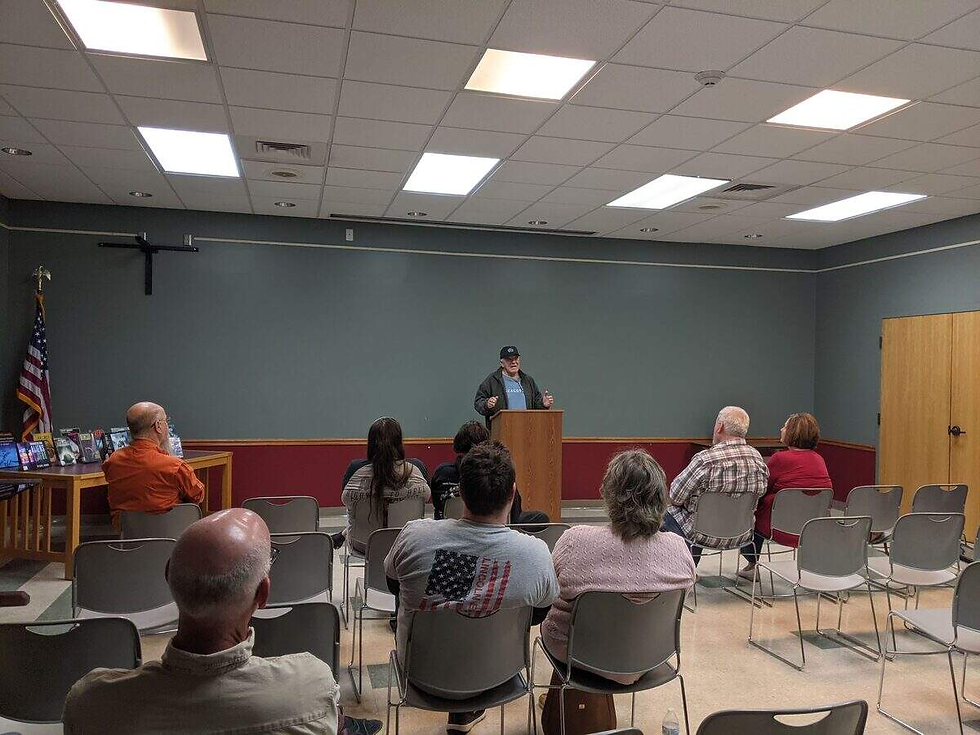
Wide photograph of Calvin Parker speaking behind a wooden lectern in a library meeting room, with several audience members seated in rows of gray chairs.
In a September 2021 interview with Alexandra Kennon Shahin for Country Roads, Parker described a more elaborate interior experience than appears in the accessible early testimony. His account included an examination surface, a small moving device, and what he recalled as an injection-like action involving a humanlike figure. Some elements differ in emphasis from the early material, while others develop themes already familiar from Hickson's accounts. This raises a precise chronological question: when did each significant detail first enter Parker's recorded narrative? A complete answer would require examination of his early interviews, any hypnosis recordings, subsequent private or public statements, and the complete circumstances of later questioning. The available interviews alone cannot distinguish every genuinely early recollection from material introduced, expanded, or reinterpreted afterward. It would be irresponsible to treat a later detailed description as independently corroborating the earlier story simply because it is vivid. It would be equally irresponsible to conclude that every late-emerging detail must be false because it was not preserved in a selected 1973 transcript.
Other Witnesses and the Problem of Independent Corroboration
The story did not remain limited to the testimony of Hickson and Parker. In 2019, local reporting described people who came forward decades later with accounts of unusual lights or events in the vicinity of the Pascagoula River. Among them, Maria Blair said she had observed a moving blue light while waiting near the river with her husband on the night of the reported encounter. Her account attracted particular interest because she associated what she remembered with the better-known abduction narrative only after hearing later descriptions. Such testimony deserves examination rather than automatic dismissal, especially if its details can be tied to independently dated observations or surviving records. Yet the delay between the reported observation and public disclosure creates obvious questions about exposure to publicity, chronology, and the precision of remembered locations. A report of an unusual light, even if accepted as sincere, does not independently verify a craft's interior or the claimed examination of two men. The correct assessment must distinguish corroboration of a possible aerial observation from corroboration of the much more specific abduction allegation.

Three adults standing beside a river on a sunny day, with Jerry Blair on the left, Maria Blair in the center, and Calvin Parker on the right holding a booklet.
The contrast with negative observations also matters. Nelson's 2018 investigation reported that a drawbridge tender near the alleged location had not seen the brightly illuminated object described by the witnesses. The absence of an observation cannot establish that nothing happened, because visibility depends on location, attention, timing, and physical obstructions. Nevertheless, it is relevant when the claim concerns an apparently conspicuous event in an industrial area. Later reports of lights must be evaluated alongside these earlier limitations, not used to erase them. Ideally, investigators would compare the original locations, viewing directions, times, and first documented statements of all relevant observers. Without that reconstruction, agreement on the presence of a light may represent only a broad similarity between different reports. The existence of additional witnesses makes the case more complex, but complexity should not be confused with confirmation of its most extraordinary claim.
Hypnosis, Memory, and Competing Explanations
The psychology of memory supplies an important framework for understanding the testimony's development, but it does not provide a ready-made solution to the Pascagoula event. Steven Frenda, Rebecca Nichols, and Elizabeth Loftus reviewed research demonstrating that memory can be influenced by information encountered after an event. Their findings support caution when comparing recollections produced after repeated interviews, exposure to other narratives, and suggestive questioning. They do not establish that a particular Pascagoula memory was false, nor do they identify the cause of the men's reported experience. Similarly, Daniel Bernstein and Loftus examined the difficulty of determining whether a particular memory accurately reflects what happened, as distinct from studying general patterns among groups of memories. Their work emphasizes the limitations of attempting to resolve specific cases through the apparent qualities of a witness or a recollection. These distinctions prevent psychological research from becoming another instrument of predetermined judgment. Memory science can clarify the conditions under which testimony develops, but it must be applied with the same caution expected of historical evidence.
The use of hypnosis in the early investigation makes those limitations especially relevant. APRO's contemporary account describes hypnotic procedures conducted after the witnesses had already been exposed to questions, expectations, and examples drawn from other reported encounters. Later scholarly work on hypnosis cautions that suggestions intended to enhance recollection can increase confidence without reliably distinguishing accurate from inaccurate details. The United States Department of Justice's guidance on forensic hypnosis similarly warns that information obtained under hypnosis must be independently checked rather than assumed to be accurate. These principles do not establish that Harder produced a false memory in either witness. They identify a methodological boundary: statements made during or after hypnosis cannot serve as independent confirmation merely because they emerge under an altered interview procedure. The most useful comparison would establish which details were recorded before hypnosis and which appeared afterward. A claim that an event was remembered more vividly under hypnosis is not equivalent to proof that the event happened as described. The relevant historical evidence lies in the sequence and conditions of reporting, not in the persuasive force of the technique.

Historical bulletin page showing two monochrome drawings of humanoid figures alongside investigation text.
Skeptical interpretations have also moved beyond the suggestion that the men simply invented their experience. In a chapter published in The Reliability of UFO Witness Testimony, Joe Nickell proposed that Hickson may have undergone a hypnagogic experience, a state near the boundary of sleep that can involve vivid perceptions, unusual imagery, and sensations resembling paralysis. Nickell argued that several features of Hickson's account were compatible with that possibility and suggested that Parker's understanding could have been influenced by their relationship. The proposal offers a naturalistic explanation for aspects of the reported experience without requiring an organized deception. Its difficulty is that compatibility with a known psychological phenomenon does not establish that the phenomenon occurred in this individual case. The surviving evidence does not include the kind of direct sleep-state observations or contemporaneous clinical assessment that would justify treating the explanation as a demonstrated diagnosis. Parker's later account of his awareness also complicates reliance on the assumption that he simply remained unconscious while Hickson experienced an altered state. Nickell's argument is therefore a serious alternative hypothesis, but its explanatory appeal should not be mistaken for independent verification of its mechanism.
Other interpretations face comparable limitations. Investigators sympathetic to the witnesses have emphasized their continued conviction, their apparent distress, and the lack of an obvious confession after they were left alone. Skeptics have identified discrepancies, questioned investigative methods, and examined whether the testimony changed in response to attention or criticism. Some of these observations are supported by identifiable documents, while others depend on retrospective character judgments or assumptions about how truthful people should behave. Neither camp gains an evidentiary advantage simply by supplying a psychologically satisfying narrative. An alien-abduction interpretation requires independent evidence for the extraordinary external event, not just credible witnesses. A deliberate-hoax explanation requires evidence of intentional fabrication rather than the mere presence of changing recollections. A psychological explanation requires a defensible connection between established mechanisms and the actual circumstances of the case. The available record supports substantial criticism of how claims were evaluated without conclusively resolving which explanation best accounts for the reported experience.
A Recording's Second Life
The archival history did not end with the original interview, the 1979 oral history, or the later documentary. In September 2026, British researcher Philip Mantle appeared on Podcast UFO to discuss historical testimony, previously overlooked recordings, and additional witnesses associated with the Pascagoula case. The episode's published description places preservation and renewed investigation among its subjects, demonstrating that the recovery of source material remains part of the case's contemporary history. Reports of newly located material are potentially significant because an early recording may preserve details unavailable in later summaries or edited reproductions. Their value depends, however, on establishing original dates, creators, physical formats, custody, copying history, and the completeness of each item. The existence of an interview does not make its statements independently accurate, just as the discovery of an older recording does not automatically validate the event described within it. A newly recovered document can materially change the record by revealing what was said, when, and under what circumstances, even if it leaves the external event unresolved. At present, the accessible episode description does not establish a fully authenticated inventory of every reported recording, nor does it justify attributing specific scenes or quotations to material not independently examined. The proper response is to treat the reported discoveries as leads for further archival comparison, not as confirmation that the central mystery has been solved.
This distinction is particularly important when older testimony circulates through modern digital platforms. A contemporary online upload may present decades-old footage with a new title, altered soundtrack, shortened introduction, or editorial context absent from the original release. A viewer encountering the video without production information may reasonably assume that the images represent the most direct available evidence of an event. In fact, audiovisual testimony is subject to the same questions that apply to printed transcripts and copied sound recordings. Who recorded it, when was it assembled, which portions were omitted, and what source material was available to its editors? The answers determine how the footage can be used responsibly in a historical reconstruction. The University of Southern Mississippi's reference to In Contact and the 1998 notice of its distribution establish useful points in the film's documented history. They do not eliminate the need to compare the online version with an authenticated original. In this respect, the documentary and the police tape illustrate different aspects of the same preservation problem.
What the Recording Ultimately Establishes
The Pascagoula case is often treated as a question about the honesty of two men, although its surviving materials support a more complicated inquiry. Hickson and Parker reported an extraordinary experience to law enforcement on October 11, 1973, and officers preserved a conversation made after direct questioning had temporarily ended. Contemporary publications document investigators' efforts to interpret their behavior, collect additional statements, and apply techniques they considered useful. Later records show how the account became public culture, how its principal narrator developed a sustained media presence, and how Parker eventually described aspects of the experience that were not prominent in the accessible early record. The documentary In Contact adds another form of testimony to that history, while recent interest in recovering older recordings raises questions about preservation and provenance. These developments are historically significant without establishing the physical reality of an unidentified craft or a medical examination by nonhuman beings. The same record cannot justify an unqualified accusation that the witnesses invented everything they reported. Its value lies in the evidence it actually preserves and the limits it makes possible to identify.
The conversation in the sheriff's office remains distinctive because it was recorded before the account had accumulated decades of public interpretation. It captured two people responding to an experience they described as real while investigators attempted to test their credibility. Their words can be studied alongside the later testimony, but they cannot be used to reconstruct an event that the recorder never witnessed. The 1979 oral history, the documentary distributed by 1998, Parker's later interviews, and subsequently reported archive discoveries each illuminate different stages of the story's development. Some may eventually clarify contradictions or reveal details absent from the published record. Others may demonstrate how repetition, changing priorities, and public attention altered the ways in which the same experience was described. The most defensible conclusion is not that the case must be accepted or dismissed in its entirety, but that each surviving account must be evaluated according to its date, provenance, purpose, and relationship to independent evidence. After the sheriff left the room, the recorder continued to run; what it preserved was testimony whose meaning would continue to be contested long after the machine stopped.
Contemporary investigations and primary-source reproductions
Aerial Phenomena Research Organization (APRO). “The Pascagoula Affair.” The A.P.R.O. Bulletin, vol. 22, no. 2, September–October 1973, pp. 1, 3–4. Contemporary investigative account covering the initial reporting, Harder's interviews, hypnotic procedures, and investigators' interpretations. Digitized reproduction examined.
Aerial Phenomena Research Organization (APRO). “Follow-Up.” The A.P.R.O. Bulletin, vol. 22, no. 3, November–December 1973, p. 6. Contemporary account discussing the concealed recording, investigator interpretations, polygraph reporting, and period illustrations by Brian James. Digitized reproduction examined.
National Investigations Committee on Aerial Phenomena (NICAP). “Miss. ‘Contact’ Case Remains Puzzle.” UFO Investigator, November 1973, p. 2. Contemporary account of the case, early investigation, and interpretation of testing. Digitized periodical available through the Center for UFO Studies.
https://cufos.org/PDFs/UFOI_and_Selected_Documents/UFOI/092%20NOVEMBER%201973.pdf
Blum, Ralph, and Judy Blum. Beyond Earth: Man's Contact with UFOs. 1974, pp. 29–36. Selected dialogue from the sheriff's-office interview and subsequent conversation. Consulted through a third-party reproduction; the complete original edition and police recording were not independently examined.
https://ufologie.patrickgross.org/htm/pascagoulatape.htm
Connors, Wendy, compiler. Pascagoula Abduction Audio Files. Historical audio compilation, reproduced by NOUFORS. Includes a sheriff's-office recording catalogue entry dated October 11, 1973, listed at 38:30. Catalogue and collection description examined; original-master authenticity and complete audio correspondence were not established.
https://noufors.com/Pascagoula_Abduction_Audio_Files.html
Institutional archives and documentary material
University of Southern Mississippi, University Libraries. “Sermon about Pascagoula Alien Abduction.” Special Collections, March 2014. Institutional account of the October 1973 report, the concealed recording, Reverend Bill Riddick's sermon, related archival material, and the In Contact video reference.
https://lib.usm.edu/spcol/exhibitions/item_of_the_month/march_2014.html
Rhodes, Andrew. “Hickson Oral History (1979).” University of Southern Mississippi Libraries, June 2022. Institutional description of Orley B. Caudill's 1979 interview with Charles Hickson, held in the Mississippi Oral History Program as volume CVIII. Collection description examined; complete interview transcript and recording not inspected.
https://lib.usm.edu/spcol/exhibitions/item_of_the_month/iotm_june_2022.html
Hickson, Charles, and William Mendez. UFO Contact at Pascagoula. 1983. Bibliographic identity established through the University of Southern Mississippi's institutional references. The book's complete text was not examined for this revision and is not used as an independently read source.
https://lib.usm.edu/spcol/exhibitions/item_of_the_month/march_2014.html
Gillis, J. R. “Pascagoula's Charlie Hickson Still Interested in UFOs.” MUFON UFO Journal, no. 362, June 1998, pp. 16–18. Contemporary interview with Hickson; editor's notice documents the commercial availability of his VHS tape In Contact.
In Contact: The Pascagoula UFO Abduction. Documentary video linked by University of Southern Mississippi Libraries. A VHS production titled In Contact was advertised in 1998. The YouTube copy was not independently viewed in full or authenticated against the original cassette; no scene-specific claims rely on that unverified comparison.
https://www.youtube.com/watch?v=FeBnI-xvJ1U
Retrospective interviews and later reporting
Nelson, Karen. “I Launched a New Investigation into the 1973 Coast UFO Abduction Story. Do You Believe?” Sun Herald, originally published October 2018; webpage updated June 24, 2019. Retrospective reporting incorporating interviews with Parker, former captain Glenn Ryder, and others.
https://www.sunherald.com/news/local/counties/jackson-county/article219679955.html
Shahin, Alexandra Kennon. “The Pascagoula Abduction.” Country Roads, September 21, 2021. Extended retrospective interview with Calvin Parker, covering his reported interior experience, his reluctance to speak publicly, and the consequences he associated with the incident.
https://countryroadsmagazine.com/art-and-culture/people-places/the-pascagoula-abduction/
Keeton, Hugh. “Pascagoula UFO: A New Witness Comes Forward.” WLOX, March 2019. Local reporting on Maria Blair's late-disclosed observations and the 2019 public reconsideration of the encounter.
https://www.wlox.com/2019/03/15/pascagoula-ufo-new-witness-comes-forward/
Willis, Martin, interviewer; Philip Mantle, guest. “782. Philip Mantle.” Podcast UFO, September 2026. Public episode description identifies discussion of newer witness reports and previously overlooked recordings associated with Pascagoula. The entire audio was not independently transcribed or reviewed for this revision; specific recovered-recording claims require direct verification.
https://podcastufo.com/782-philip-mantle/
Nickell, Joe. “The Pascagoula Abduction: A Case of Hypnagogia?” In The Reliability of UFO Witness Testimony, published 2023, pp. 137–140. Examines a sleep-related alternative interpretation of the reported encounter. Available chapter text examined.
https://zenodo.org/records/10581338
Memory, hypnosis, polygraph, and oral-history methodology
Frenda, Steven J., Rebecca M. Nichols, and Elizabeth F. Loftus. “Current Issues and Advances in Misinformation Research.” Current Directions in Psychological Science, vol. 20, no. 1, 2011, pp. 20–23. DOI: 10.1177/0963721410396620. Publisher abstract examined; complete restricted journal article not claimed read.
https://www.psychologicalscience.org/journals/current-directions/0963721410396620/
Bernstein, Daniel M., and Elizabeth F. Loftus. “How to Tell If a Particular Memory Is True or False.” Perspectives on Psychological Science, vol. 4, no. 4, 2009, pp. 370–374. DOI: 10.1111/j.1745-6924.2009.01140.x. Bibliographic information and relevant openly hosted author-copy text examined.
National Research Council. The Polygraph and Lie Detection. Washington, DC: National Academies Press, 2003. DOI: 10.17226/10420. Executive summary and scientific limitations reviewed through the publisher's accessible text.
https://www.nationalacademies.org/read/10420/chapter/2
United States Department of Justice. “Use of Hypnosis—Purpose.” Archived U.S. Attorneys' Manual, Criminal Resource Manual §287. Institutional guidance describing the limitations and corroboration requirements associated with forensic hypnosis.
https://www.justice.gov/archives/usam/criminal-resource-manual-287-use-hypnosis-purpose
Oral History Association. “Oral History Best Practices.” Institutional guidance on interview preparation, source context, preservation, access, and interpretation.
Image Sources & Credits
Image 1 — Charles Hickson and Calvin Parker, October 1973. Photograph by Gary Holland / Mississippi Press, via Associated Press. Published in the Sun Herald archival reporting on the Pascagoula case.
Image 2 — Charles Hickson at the Pascagoula River, December 15, 1977. Photograph by Mike Ramsey / Sun Herald archive. Hickson was photographed during a later film-crew interview at the reported encounter location.
Image 3 — The Mississippi Press, October 12, 1973. Archival newspaper clipping of the original Pascagoula UFO report, reproduced in Our Mississippi Home. Original publication: The Mississippi Press, Pascagoula, Mississippi.
Image 4 — Pascagoula-related APRO audio cassettes. Photograph from the David Marler / National UFO Historical Records Center collection, reproduced in Astonishing Legends. The photographed tapes are associated with later archival recovery and are not identified here as the original sheriff's-office recording master.
Image 5 — Beyond Earth: Man's Contact with UFOs (1974). Ralph Blum with Judy Blum. Bantam Books paperback, photographed in a fourth-printing copy offered by Chamblin Bookmine. Original cover designer not established.
Image 6 — The A.P.R.O. Bulletin, September–October 1973. Aerial Phenomena Research Organization, vol. 22, no. 2, printed page 4. Historical investigation text concerning Pascagoula and the use of hypnosis. Digitized periodical reproduced by NOUFORS.
Image 7 — UFO Investigator, November 1973. National Investigations Committee on Aerial Phenomena (NICAP). “Miss. ‘Contact’ Case Remains Puzzle,” printed page 2. Historical periodical reproduced by the Center for UFO Studies.
Image 8 — Visitors from Outer Space: What Saith the Lord? (1973). Record sleeve for Reverend Bill Riddick's sermon, delivered on October 14, 1973. Cover artist unidentified. Collection and digital image: University of Southern Mississippi Libraries, Special Collections.
Image 9 — Charles Hickson Oral History, 1979. Title page from the Mississippi Oral History Program, Volume CVIII. Interview conducted by Dr. Orley B. Caudill. University of Southern Mississippi Libraries, Special Collections.
Image 10 — In Contact-associated archival artwork. Artwork reproduced from materials associated with Charles Hickson by The Philadelphia Experiment From A–Z. The source connects the artwork with Hickson's documentary; its identification as original VHS packaging has not been established. Artist not independently identified.
Image 11 — Calvin Parker speaking in March 2022. Photograph by Gautama Mehta / Sun Herald, taken at the Lucedale–George County Public Library on March 14, 2022.
Image 12 — Jerry Blair, Maria Blair, and Calvin Parker, 2019. Photograph reproduced in the Astonishing Legends Pascagoula archival image collection. Photographer not independently identified.
Image 13 — Pascagoula Illustrations, 1973. Drawings by Brian James, published in The A.P.R.O. Bulletin, November–December 1973, vol. 22, no. 3, printed page 6. Aerial Phenomena Research Organization. Digitized periodical reproduced by NOUFORS. The illustrations represent reported testimony rather than photographic documentation.
Comments