top of page

The Times of London on November 6, 1840, printed this account from a correspondent in the Bahamas:


The Discovery of An Abandoned French Vessel: Curious Circumstances

A large French vessel, bound from Hamburg to Havana, was met by one of our coasters, and was discovered to be completely abandoned.... The cargo, composed of wines, fruits, silks, etc., was in the most perfect condition. The captain's papers were all secure in their proper places.... The only living things on board were a cat, some fowles, and several canaries half-dead with hunger. ... The vessel, which must have been left within a very few hours, contained several bales of goods addressed to different merchants in Havana. She is very large, recently built, and called Rosalie. Of her crew and passengers no intelligence has been received.


A search of insurance record sat Lloyd’s of London revealed what at first looked like a simple confusion: Lloyd's files described the Rossini, a ship on the Hamburg-Havana run, as going aground in the Bahama Channel on August 3. Those aboard the vessel were taken ashore, and on August 17 the Rossini was towed into Nassau by salvage ships.


And yet, what had given the Times correspondent the impression that the Rosalie / Rossini (if indeed only one ship was involved) had been abandoned ''within a very few hours,” especially if the canaries aboard were starving? Wouldn't the captain have taken his ship’s papers when he was rescued? Wouldn't the arrival of the rescued passengers have been fresh news in Nassau? And what were the “curious circumstances” alluded to in the salvage courts records concerning the Rossini?


- SOURCE: Paul Begg, Into Thin Air: People who disappear, p.52
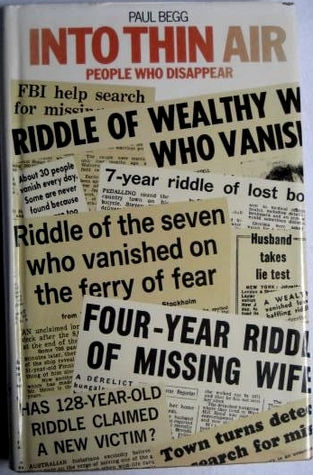
Paul Begg, Into Thin Air: People who disappea

ABOUT AUTHOR: Paul Begg is acknowledged worldwide as one of the leading authorities on the Jack the Ripper mystery. He has worked in newspapers, television and publishing. He has written extensively on Jack the Ripper, including Jack the Ripper: The Uncensored Facts, Jack the Ripper: The Definitive History and Jack the Ripper: The Facts. He is also the author of Into Thin Air, The Scotland Yard Files and Mary Celeste: The Greatest Mystery of the Sea. Paul was formerly the editor of the Ripperologist magazine and has appeared as an historical advisor on several television programmes.


One reason the parental advice “never accept candy from strangers” became a very familiar phrase was the sensational July 1874 kidnapping of Charley Ross, the four-year-old son of a wealthy businessman in Germantown, Pennsylvania.


Charley and his six-year-old brother, Walter, were accustomed to playing near the road in front of their home. During the last week of June, two strangers in a carriage stopped each day to talk to them and offer candy. Then, on July 1, they offered to take the boys into Philadelphia to buy fireworks for Independence Day. In the city they sent Walter into a store with 25 cents, a princely sum for a six-year-old in those days. When Walter came out of the store, the carriage, the two men, and Charlie were gone.


Two days later the boys’ father, Christian K. Ross, received an illiterate, barely legible note warning him: “. . .dont deceiv yuself an think the detectives can git him from us for that is one impossible—you here from us in few day” Soon there came a demand for a $20,000 ransom, but an attempt at a rendezvous for the delivery of the money fell through.


The New York City police identified the handwriting of the notes as that of William Mosher, a dock thief, but before they could track him down Mosher and his accomplice, Joseph Douglass, were shot during a burglary in Bay Ridge, New York. Mosher died at once; Douglass survived long enough to confess but claimed that only Mosher had known Charley’s whereabouts. Little Walter Ross identified the two dead as the kidnappers of his brother.


1924 Newspaper article about the kidnapping of Charley Ross 50 years earlier; credit New York Times.
Later, a book about Charley Ross was published in 1967, written by Norman Zierold.
Today, Charley Ross bottles from the mid to late 1870's are very difficult to find. But once in a while “diggers” will discover them in their searches as they go through old trash dumps and privy pits.
A fascinating bottle of historical importance that marks a sad event in American history. The admonition "don't take candy from strangers" is said to have originated from Charley Ross' kidnapping.


The mother's brother-in-law, a former policeman named William Westervelt, was tried for his alleged part in the crime. Sentenced to seven years of solitary confinement, he never admitted guilt on his release in 1882 he dropped out of sight.


Source: Frank Leslie's Illustrated Newspaper, August 15, 1874; June 18, 1875; Harper's Weekly,August8,1874,p.652


bottom of page