top of page

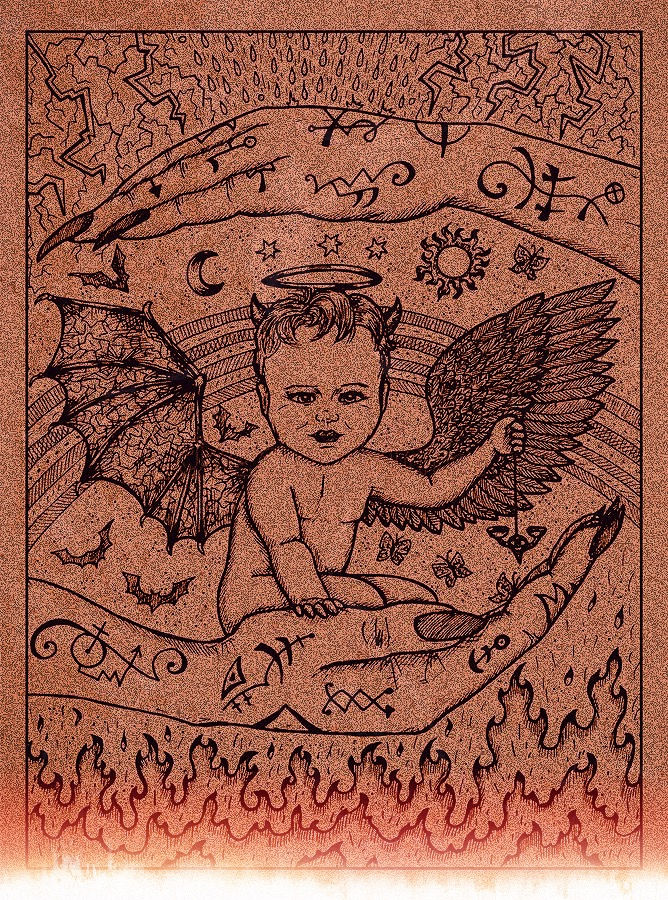
From The Innocent Souls: The Devil's Contortions (Demons and Exorcism)

For reasons unknown, perfectly normal people sometimes suddenly exhibit a dramatic change of being. Their actions become violent and seemingly inhuman. They may expel foul substances, utter shocking profanities, make strange animal sounds, and distort their bodies in extraordinary ways. In some circles such actions are considered to be evidence of possession by the Devil, for which the only antidote is the ritual of exorcism.


In 1865 something ghastly entered the lives of two young boys in the small town of Illfurth, in Alsace, France. They were Joseph and Theobald Bruner, nearly 8 and 10 years old respectively, the sons of a farmer. According to records kept by Father Karl Brey, the parish priest, the first signs that something was seriously wrong with the children were their fascination with diabolic things and their aversion to anything of a religious nature:


While lying in their bed, the children used to turn to the wall, paint horrible Devil faces on it, and then speak to the faces and play with them. If, while one of the possessed was asleep, a rosary was placed on his bed, he would immediately hide under the covers and refuse to come out of hiding until the rosary was removed.


More extraordinary were the physical contortions the boys underwent.


They entangled their legs every two or three hours in an unnatural way. They knotted them so intricately that it was impossible to pull them apart. And yet, suddenly, they could untangle them with lightning speed. At times the boys stood simultaneously on their heads and legs, bent backwards, their bodies arched high. No amount of outside pressure could bring their bodies into a normal position—until the Devil saw fit to give these objects of his torture some temporary peace.


By these and other bizarre manifestations Father Brey was persuaded that the brothers were the victims of demonic possession.


At times, their bodies became bloated as if about to burst; when this happened, the boy would vomit, whereby yellow foam, feathers, and seaweed would come out of his mouth. Often, their clothes were covered with evil smelling feathers....

No matter how often their shirts and outer clothing were changed, new feathers and seaweed would appear. These feathers, which covered their bodies in some inexplicable way, filled the air with such a stench that they had to be burned. …


If further evidence that the boys were in the grip of a supernatural power had been needed, it was given in their frequent displays of clairvoyance.


The fascination with witches and demons that took root in the late 18th century burst into full flower in the early 19th. This wild, swirling evocation of a witches’ dark ritual—held, blasphemously, in a church—is full of uncontrollable demonic energy. The intensity of the scene would have held great appeal in these decades, when extremes of emotion were savored...Pictured: "The Witches' Sabbath" (1828), Louis Boulanger, on view in "Phantasmagoria."
"The Witches' Sabbath" (1828), Louis Boulanger

Theobald several times predicted the death of a person correctly. Two hours before the death of a Frau Muller, the boy knelt by his bed and acted as if he were ringing a mourning bell. Another time he did the same thing for a whole hour. When he was asked for whom he was ringing, the boy answered, “For Gregor Kunegel.” As it happened, Kunegel's daughter was visiting in the house. Shocked and angry, she told Theobald, “You liar, my father is not even ill. He is working on the new boys’ seminary building as a mason.” Theobald answered, “That may be, but he just had a fall. Go ahead and check on it!” The facts bore him out. The man had fallen from a scaffold, breaking his neck. This happened at the very moment that Theobald made the bell-ringing motions. No one in Illfurth had been aware of the accident.


When their parents and Father Karl Brey decided that exorcism was the only effective way of helping the boys, Theobald was sent to the St. Charles Orphanage at Schiltigheim near Strasbourg. The orphanage was run by nuns, and its superior was one Father Stumpf. For the first three days after his arrival, Theobald—or the diabolic entity was silent, but on the fourth day he said, “I have come, and I am in a rage.” One of the nuns asked, “And who are you?” A nonhuman voice answered: “I am the Lord of Darkness!” Later on Joseph was also sent to the orphanage.


Throughout the prolonged period of exorcism, performed by Father Stumpf, the demonic possession of the two brothers was manifested in many ways. Both boys, for instance, became infested with red head lice, which multiplied so quickly that three or four people with brushes and combs were not able to keep pace with them. Eventually, the priest poured holy water on the vermin, and they disappeared.


In all, the possession of Theobald and Joseph Bruner lasted four years before they were freed by the rites of exorcism. Theobald died two years later, on April 3, 1871, when he was 16. Joseph, in whom the symptoms had been less severe, died in 1882.


GÖTZENDIENST (IDOLATRY) BY MICHAEL HUTTER

When Clara Germana Cele was 16 years old, she made a pact with Satan—or so she told, her confessor, Father Erasmus Horner, at the mission school she had attended since she was four years old. In the weeks following her confession, Germana began to behave wildly, and on August 20, 1906, she alarmed the sisters in charge by tearing her clothes, breaking one of the posts on her bed, growling and grunting like an animal, and seeming to converse with invisible beings. In a more lucid moment she called out: “Sister, please call Father Erasmus. I must confess and tell everything. But quick, quick, or Satan will kill me. He has me in his power! Nothing blessed is with me; I have thrown away all the medals you gave me.” Later that day she again called out: “You have betrayed me. You have promised me days of glory, but now you treat me cruelly.”


Until these outbursts began, the priests and nuns of the Marianhill Order mission school in Umzinto, about 50 miles south of Durban, South Africa, had considered Germana a normal, healthy, although somewhat erratic young person. As her condition worsened, Germana began to manifest the signs by which the Roman Catholic Church identifies cases of demonic possession. Holy water, for example, burned her when she was sprinkled with it or given it to drink, but when she was sprinkled with ordinary water with which the font had secretly been filled, she simply laughed. She complained vigorously whenever a cross was brought near her and could detect the presence of a religious object, such as a small fragment of a cross, even when it had been heavily wrapped or otherwise concealed.


Germana also developed a more wide-ranging clairvoyance. She was able to describe the daily details of a priests journey from Africa to Rome, including the addresses of the places where he stayed along the way. And, to shame one young man who made fun of her, she revealed scandalous details of his private life, complete with dates, times, and names.


Among Germana s physical manifestations, her confessor reported numerous instances of levitation:


Germana floated often three, four, and up to five feet in the air, sometimes vertically, with her feet downward, and at other times horizontally, with her whole body floating above her bed. She was in a rigid position. Even her clothing did not fall downward, as would have been normal; instead, her dresses remained tightly attached to her body and legs. If she was sprinkled with holy water, she moved down immediately, and her clothing fell loosely onto her bed. This type of the phenomenon took place in the presence of witnesses, including outsiders. Even in church, where she could be seen by everyone, she floated above her seat. Some people tried to pull her down forcibly, holding on to her feet, but it proved to be impossible.


Another curious physical capacity that astonished the attending priests and nuns was her ability to transform herself into a snakelike creature. Her whole body would become as flexible as rubber, and she would writhe along the floor. At times her neck seemed to elongate, thereby enhancing the serpent like impression she gave. Once, while she was being restrained, she darted, like lightning, at a nun kneeling in front of her and bit the poor woman on the arm. The wound showed the marks of Germana's teeth and a small red puncture resembling a snakebite.


On September 10, 1906, permission for Germanas exorcism was given, to be performed by Father Erasmus, her confessor, and by Father Mansuet, the mission rector. The rites began in the morning, lasted till noon, began again at 3 p.m., and continued well into the night. The next morning they began at 8 and lasted until 10. Under fierce pressure from the two exorcists, the possessing demon said that he would signal his departure by an act of levitation; this occurred before 170 witnesses in the mission chapel. Prayers of thanks were later given.


In January 1907, while Father Erasmus was away, Germana suffered a relapse and made a new pact with theDevil. On April 24 a new exorcism began. It lasted for two days and was successful, the Devil’s final departure being signaled by an incomparably foul smell.


SOURCES:

I - Demon Children, Martin Ebon, ed., pp.154-64

II - Adolf Rodewyk, Possessed by Satan, pp.120-27


© 2019 - 2026 DAILY STRANGE ALL RIGHTS RESERVED ™

bottom of page